
The link below has answers to the question please use it to check yourself: http
ID: 2046870 • Letter: T
Question
The link below has answers to the question please use it to check yourself:
http://i1057.photobucket.com/albums/t396/DODGEVIPER2013/answerstotherest.jpg
11. In separate experiments, four different particles each start from far away with the same speed and impinge directly on a fixed particle of charge Q 0. The masses and charges of the particles are particle 1: mass mo, charge go 0 particle 2: mass 2mo, charge 2go particle 3: mass 2mo, charge go/2 particle 4: mass mo/2, charge 2go Rank the particles according to the distance of closest approach to charge Q, from smallest to largest. HINT: Use energy considerations.) a) 1.2. 3.4 by 4. 3.2.1 c) 3. 1 and 2 tie, then 4 d) 4, 1 and 2 tie, then 1 e) 1 and 2 tie, then 3.4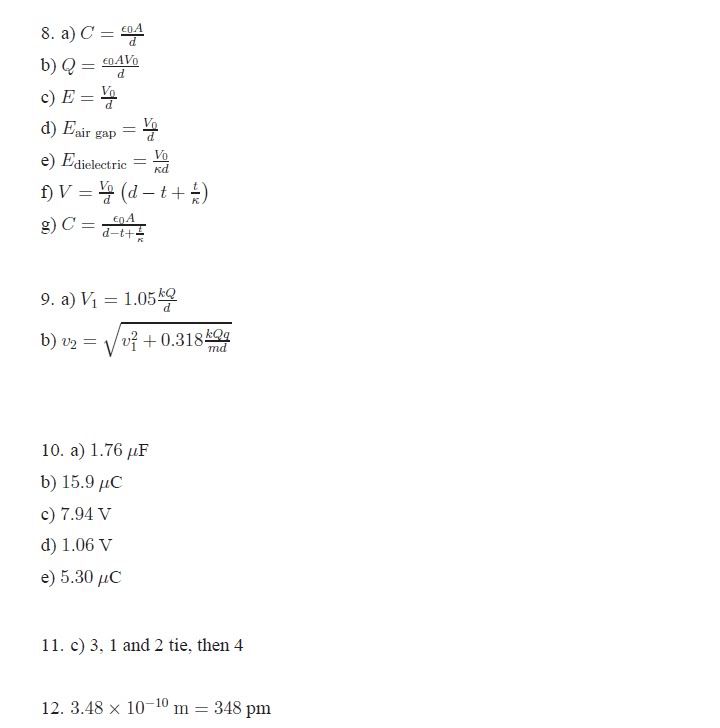
Explanation / Answer
Initially energy is given as:
E1=Kinetic energy=0.5*m*v2
The particle will stop when the K.E will convert to Electric potential energy.
Electric potential energy =k*q/r
For 1st particle:
0.5*m*v2=k*q/r
Thus ,r=2kq/mv^2
Let kq/mv^2=p
r1=2p
For 2nd particle:
0.5*2m*v2=k*2q/r
Thus ,r=2kq/mv^2
r2=2p
For 3rd particle:
0.5*2m*v2=k*q/r2
Thus ,r=kq/2mv^2
r3=p/2
For 4th particle:
0.5*m/2*v2=k*2q/r
Thus ,r=8kq/mv^2
r4=8p
order is:
3rd particle<1st particle=2nd particle<4th particle
Related Questions
Navigate
Integrity-first tutoring: explanations and feedback only — we do not complete graded work. Learn more.