
1- Review this conceptual example before attempting this problem. The truck in t
ID: 2245487 • Letter: 1
Question
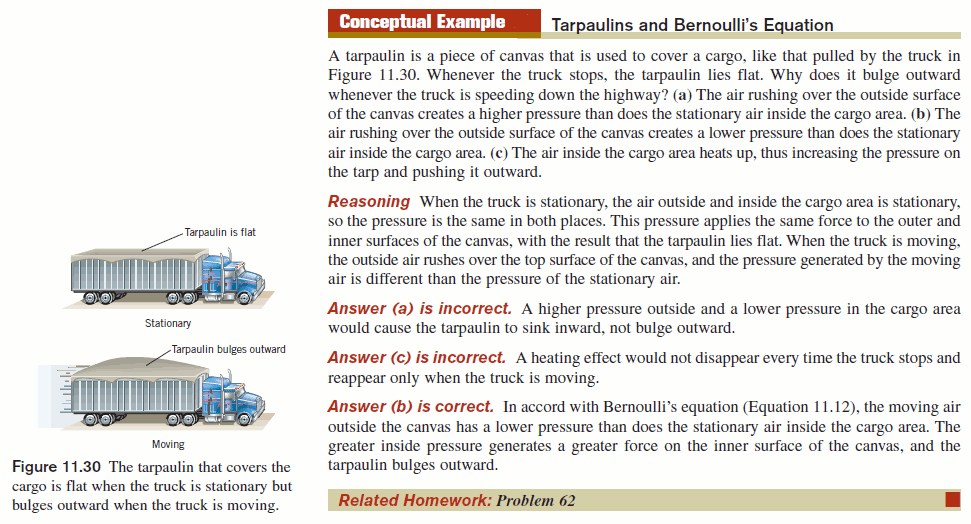
1- Review this conceptual example before attempting this problem. The truck in that example is traveling at 35 m/s. The density of air is 1.21 kg/m3. By how much does the pressure inside the cargo area beneath the tarpaulin exceed the outside pressure?
2- Poiseuilles' law remains valid as long as the fluid flow is laminar. For sufficiently high speed, however, the flow becomes turbulent, even if the fluid is moving through a smooth pipe with no restrictions. It is found experimentally that the flow is laminar as long as the Reynolds number Re is less than about 2100.
Review this conceptual example before attempting this problem. The truck in that example is traveling at 35 m/s. The density of air is 1.21 kg/m3. By how much does the pressure inside the cargo area beneath the tarpaulin exceed the outside pressure? Poiseuilles' law remains valid as long as the fluid flow is laminar. For sufficiently high speed, however, the flow becomes turbulent, even if the fluid is moving through a smooth pipe with no restrictions. It is found experimentally that the flow is laminar as long as the Reynolds number Re is less than about 2100. Re = 2 v?R / ? Here v, ?, and ? are, respectively, the average speed, density, and viscosity of the fluid, and R is the radius of the pipe. Calculate the highest average speed that blood (? = 1060 kg/m3, ? = 4.00 times 10-3 Pa middot s) could have and still remain in laminar flow when it flows through the aorta (R = 7.60 times 10-3 m).Explanation / Answer
1) P1-P2 = 1/2 rho(v2^2-v1^2)= 0.5*1.21*35^2 = 741.125 pa
2) V = (Re)n/2pR = 2000*4*10^-3 / 2*1060*7.6*10^-3
= 0.47 m/s
Related Questions
Navigate
Integrity-first tutoring: explanations and feedback only — we do not complete graded work. Learn more.