
Richard has just been given a 4-question multiple-choice quiz in his history cla
ID: 2961298 • Letter: R
Question
Richard has just been given a 4-question multiple-choice quiz in his history class. Each question has five answers, of which only one is correct. Since Richard has not attended class recently, he doesn't know any of the answers. Assuming that Richard guesses on all four questions, find the indicated probabilities. (Round your answers to three decimal places.) (a) What is the probability that he will answer all questions correctly?
(b) What is the probability that he will answer all questions incorrectly?
(c) What is the probability that he will answer at least one of the questions correctly? Compute this probability two ways. First, use the rule for mutually exclusive events and the probabilities shown in the binomial probability distribution table.
Then use the fact that P(r ? 1) = 1 ? P(r = 0).
Compare the two results. Should they be equal? Are they equal? If not, how do you account for the difference?
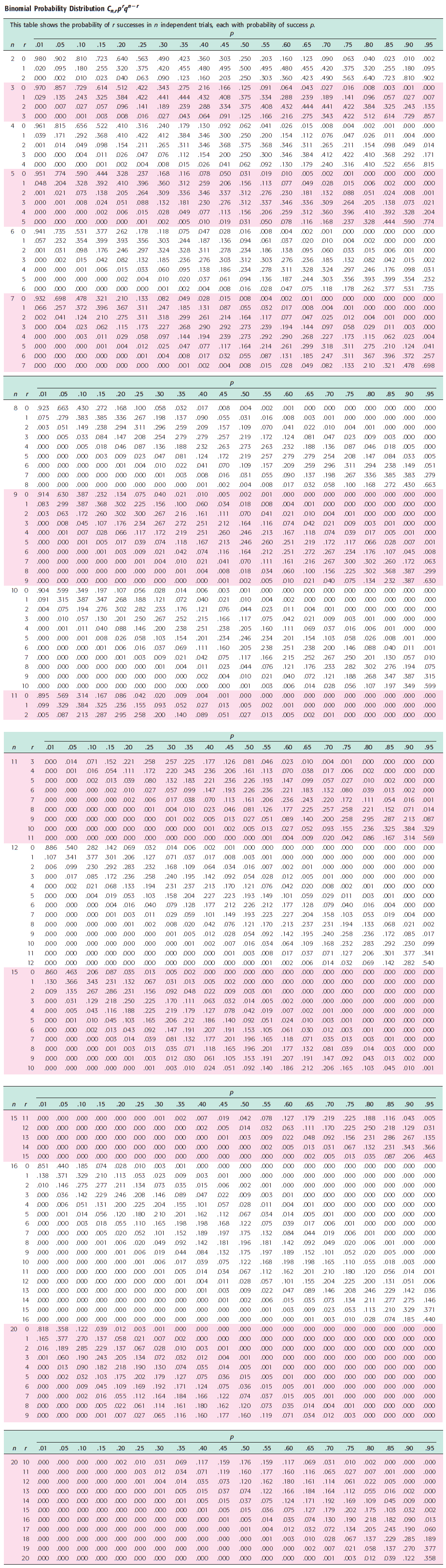
(d) What is the probability that Richard will answer at least half the questions correctly?
Explanation / Answer
each question has five answers
so probability of guessing a question right=1/5
so probability of guessing a question wrong=4/5
NOTE : P(0)+P(1)+P(2)+P(3)+P(4)=1
a)there are 4 questions
so prob(all right)=1/5*1/5*1/5*1/5=1/625=0.0016
b)so prob(all wrong)=4/5*4/5*4/5*4/5=256/625=0.4096
c)method 1:
probability that he will answer at least one of the questions correctly=P(1)+P(2)+P(3)+P(4)= 4Cx (1/5)^x (4/5)^(4-x)..(x=1 to 4)
=4C1 (1/5)^1(4/5)^3 + 4C2 (1/5)^2(4/5)^2 + 4C3(1/5)^3(4/5)^1 + 4C4 (1/5)^4(4/5)^0=369/625=0.5904
method 2:
probability that he will answer at least one of the questions correctly=1-prob(he will answer 0 of the questions correctly)=1-P(0)=1-4/5*4/5*4/5*4/5=1-0.4096=369/625=0.5904
yes they should be equal.
d)probability that Richard will answer at least half the questions correctly=p(2)+p(3)+p(4)=1-p(0)-p(1)
p(o)=0.4096 ...from(b)
p(1)=4C1 (1/5)^1(4/5)^3=0.4096
so probab=1-p(0)-p(1)=113/625=0.1808
Related Questions
drjack9650@gmail.com
Navigate
Integrity-first tutoring: explanations and feedback only — we do not complete graded work. Learn more.