
a) why are the two focal length of the cylindrical lens not equal? b) How would
ID: 2134540 • Letter: A
Question
a) why are the two focal length of the cylindrical lens not equal?
b) How would you alter the shape of the lens to reduce the amount of cylindrical aberration?
c) its possible to obtain a non-inverted real image with a converging lens? A non-inverted virtual image? explain
d) For any converging lens of focal length f, where would you place the object to obtain an image as far away as possible?. How large would the image be?
Explanation / Answer
If a patient has an astigmatism, he needs a toric lens to see clearly. The geometry of a toric lens focuses light differently in different meridians. For example, a toric lens, when rotated correctly, could focus a horizontal line to a series of points at one focal distance while focusing a vertical line to a separate focal plane. This photo helps to illustrate this concept.
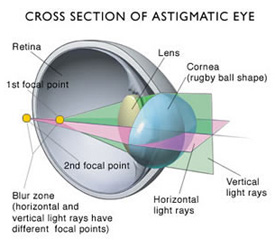
The power of a toric lens can be specified by describing how the cylinder (the meridian that is most different from the spherical power) differs from the spherical power. Power evenly transitions between the two powers as you move from the meridian with the most convergence to the meridian with the least convergence or most divergence. For regular toric lenses, these powers are perpendicular to each other and their location relative to vertical and horizontal are specified by the axis component.
There are two different conventions for indicating the amount of cylinder: "plus cylinder notation" and "minus cylinder notation". In the former, the cylinder power is a number of diopters more convergent than the sphere power. That means the spherical power describes the most divergent meridian and the cylindrical component describes the most convergent. In the latter, the cylinder power is a number of diopters more divergent than the sphere component. Thus the sphere power describes the most convergent meridian and the cylinder component describes the most divergent. Europe typically follows the plus cylinder convention while the US typically follows the minus cylinder convention. Minus cylinder notation is also more common in Asia, although either style may be encountered there. There is no difference in these forms of notation and it is easy to convert between them: simply add the sphere and cylinder numbers together to produce the converted sphere
Related Questions
drjack9650@gmail.com
Navigate
Integrity-first tutoring: explanations and feedback only — we do not complete graded work. Learn more.